A Day in the Life: Anne Butcher, Head of Studio, The Royal School of Needlework
With our love of embroidery, we are absolutely delighted to welcome our Day in the Life guest, Anne Butcher, to the Art Journal this month. Anne is Head of Studio at the Royal College of Needlework.
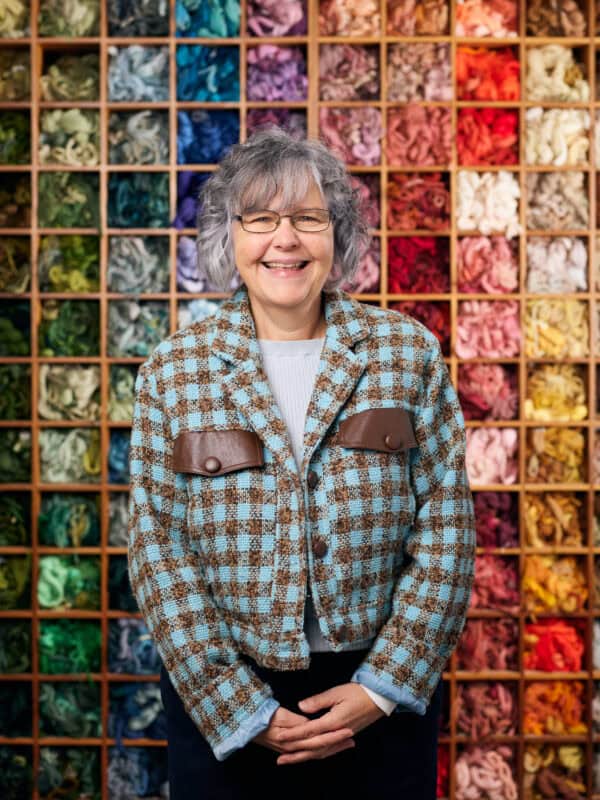
Anne Butcher, Head of Studio, Royal School of Needlework
Anne started an apprenticeship at the Royal School of Needlework in 1982 and has over 40 years of embroidery experience and knowledge both as an embroiderer and manager of a wide range of embroidery and textile projects. Anne has experience in a range of teaching from community and adult learning to Degree level. Anne has developed her embroidery skills to not only use traditional techniques but to develop them becoming increasingly innovative with her approach combine other textile practises with her embroidery background. She has strong links to the education provisions of the RSN and has, herself, taught a vast variety of techniques. Anne has developed her embroidery skills to not only use traditional techniques but to develop them becoming increasingly innovative with her approach combining other textile practises with her embroidery background.
How does a good day begin:
A good day begins with a traffic free early commute to work and a dry walk across the green and up the main driveway of Hampton Court Palace, where the Royal School of Needlework has been based since 1987. The RSN Embroidery Studio is at the back of the Palace and looks out on the gardens of the East Front. As I am often in first, it is a pleasure to open the shutters to see what the day is bringing. A good day may bring a stunning sunrise, sunshine, or a clear frosty morning.
What is the first thing you do when you start work:
In all honesty, after checking the post room on the way through the Palace, I put the kettle on and log in. Studio Manager Gemma Murray is also in early, so this is often a good time for a catch up and a check of the plans for the day. If we need to move any of the Studio around to start a new commission or to continue an already started piece, we get this done early so there is less disruption to the staff.
What are you currently working on:
The Studio has just finished the embroidery for the curtains at the Royal Opera House and are planning the construction of 4 x 6-metre-long replica curtains, as well as the final stages of the project management for a large community project between the Worshipful Company of Upholders, 12 Cathedrals throughout the UK and Fine Cell. Lastly, we are starting the components of a large celebratory panel, approximately 3 metres wide. Later this month, we will start planning our budget for 2026-27.
What does your job continue to teach you:
My job continues to teach me the importance of flexibility and problem-solving, but most of all teamwork, and how essential this is when deadlines are looming and problem-solving is required. We have a talented core team who continue to bring a wealth of knowledge, not only from the skills they learn though the RSN, but often from their own professional practice and previous careers. All this creates an environment where we can not only maintain the traditional processes, but adapt them to work for the requirements of today.
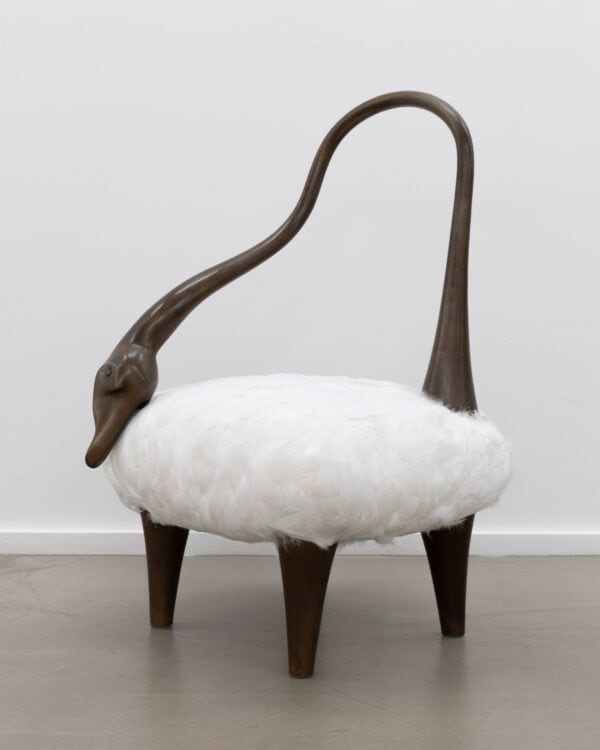
Cast Iron Chair designed by Florencia Bacci working with a foundry and the Studio at the Royal School of Needlework to produce the finished piece.
Influential piece/s of art and why do they mean so much to you:
This is a really difficult question and, having pondered my answer, I keep going back to the Raphael Cartoons of the Tapestries commissioned by Pope Leo X for the Sistine Chapel in the Vatican Palace. Several years ago, I completed an Open University Degree and wrote about these for one of my final papers.
I reviewed them as practical working drawings, looking at how they would have been used compared to how we would use them today. I considered who drew and painted them, and who would have ultimately used them, the weavers. I looked at how they had been drawn, allowing for the difference in techniques, paint opposed to thread, and the evidence of changes to details or the amount of detail to be included or not included as they were to be woven. By studying them closely, there is a suggestion of multiple hands involved, which is fascinating to see at the design stage and, for a project of this size, no different from our approach. Considering there would have been a team of weavers, it was important for them to work as if the piece had been worked by one person, something our studio excels at. For me, having been working with fabric and thread for most of my career, it was inspiring to see a world class artist apply his talents to textiles, elevating textiles into an art form.
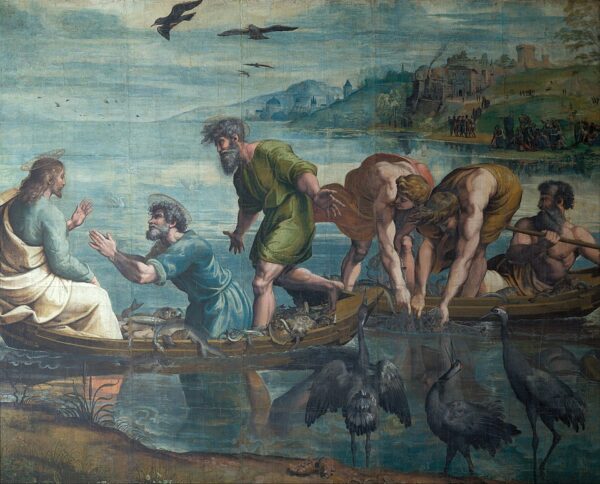
The Miraculous Draught of Fishes, 1515, one of the seven remaining Raphael Cartoons for tapestries for the Sistine Chapel (Victoria and Albert Museum)
Most productive part of your day:
The most productive part of my day is either between 8.00 and 9.00am or between 14.30 and 17.00, when the phones are quieter and there are not so many people onsite, or everyone has settled into their tasks for the day.
Essential skills or training for your role:
Essential skills would be my training as an Apprentice at the Royal School of Needlework, along with other training in areas such as conservation, restoration and contemporary embroidery. I love to learn, there is always something you can improve on or a skill that can be developed. I do very much prefer hands on courses that I may be able to bring into a studio commission at a later stage or share with a student.
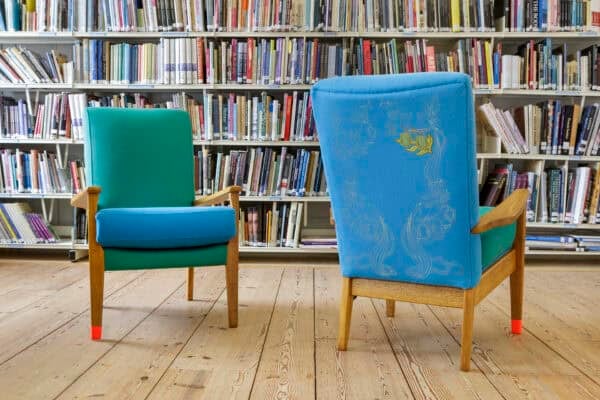
Two chairs created by the Royal School of Needlework in collaboration with Jay and Co
How do you decompress once you finish work:
I have a drive home, so singing along to music is a good way to decompress and, as long as the traffic is moving, nobody can hear me! Often in the evening, I will sit and work on half-inch hexagons, which one day be a very colourful full-size quilt and has already been going for a large number of years!
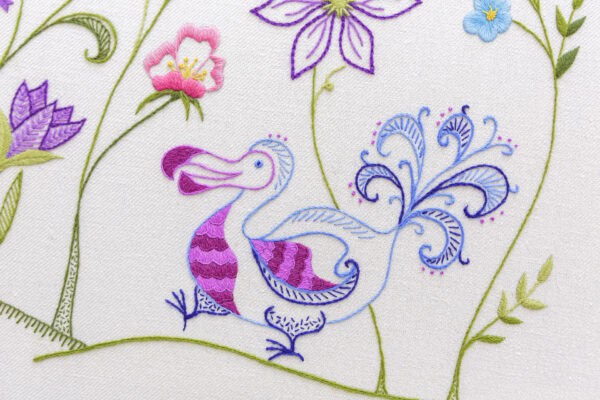
A bespoke crewelwork embroidered stool designed and embroidered by the studio for a family birthday gift.
Looking back, what remains your most rewarding professional experience:
There have been a number, but I would have to say the most rewarding experience has to be overseeing with Gemma Murray and the Studio team, the 9 projects for the Coronation of His Majesty King Charles III, closely followed by the new set of curtains for the Royal Opera House, Covent Garden, London. When we worked on the ROH house back in 1997-99, I went on maternity leave so did not see them through, making it even more special this time.
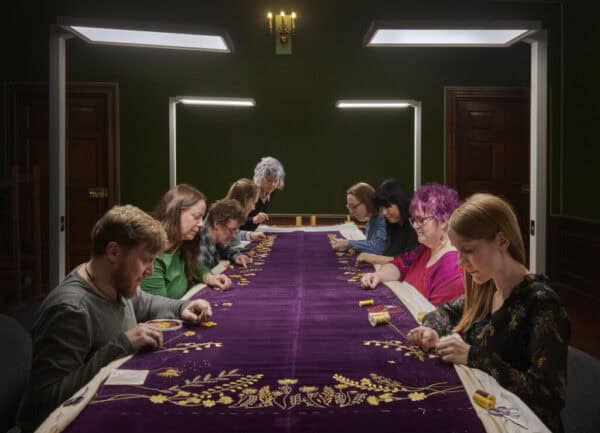
Embroiderers at The Royal School of Needlework working on the Robe of Estate for Her Majesty the Queen.
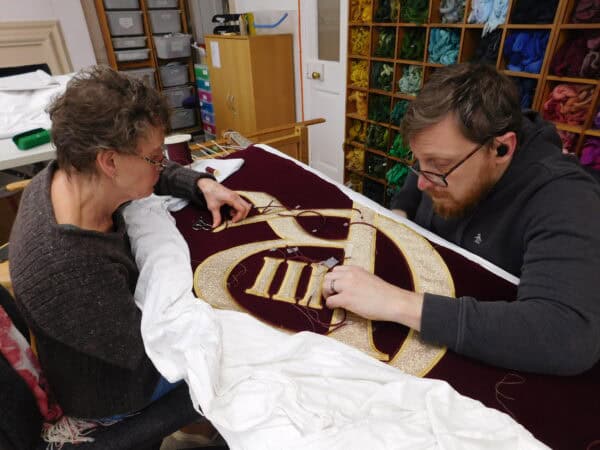
Helen Stevens and Matthew Cayton working on the curtains for the Royal Opera House, Covent Garden, London
If you could take any piece of artwork home with you for a weekend, what would it be:
This would have to be one or all of the albums containing paper mosaics/collages produced by an embroiderer called Mrs Mary Delaney. She was born in 1700 and was a prolific embroiderer however, at the age of 80, she took up making paper mosaics of flowers and plants. They were botanically correct and often taken from specimens brought back from expeditions and given to her by the botanists, allowing her to take the plants apart and replicate them correctly as a way of recording them for the future. The background of each flower and plant was black and every coloured piece of paper, at that time, had to be dyed. I have used images of these as inspiration both for myself and my students when I was still teaching regularly. Mrs Mary Delaney produced a 1000 paper mosaics before she passed away at the age of 88. Even without having any housework to do that is an incredible amount of work in eight years.