A Day in the Life: Annemarie Bilclough, Frederick Warne Curator of Illustration, Victoria and Albert Museum
It is an enormous pleasure to welcome to the Journal this month, Annemarie Bilclough, who is the Frederick Warne Curator of Illustration at the Victoria and Albert Museum in London.
Annemarie has worked at the V&A for more than 25 years, contributing to a variety of projects, from exhibitions on Art Deco and Arts and Crafts to small displays on botanical illustration and art inspired by maps. She contributed work on Rembrandt for the museum’s Europe 1600-1800 galleries, and was co-curator of Winnie-the-Pooh: Exploring a Classic (2017), Making an Impression: the art of relief printmaking (2019), Alice: Curiouser and Curiouser (2020), and Beatrix Potter: Drawn to Nature (2022).
How does a good day begin:
My dream day would be leisurely waking up to sunshine and an alfresco breakfast, though I usually settle for a cup of tea, and ideally would have an unrushed stroll through the park to the station.
What is the first thing you do when you start work:
I try to arrive early and relax in the staff canteen with a cup of tea and breakfast. I check my main goals for the day and try to clear some easy admin.
What are you currently working on:
I oversee the V&A Illustration Awards which is in the final stages of preparation for the display before the prize giving ceremony and private view on 1 July. I am also researching women scientific illustrators as contextual background towards large project on Beatrix Potter and planning an object list and narrative for a smaller display on Beatrix Potter artworks of interiors, both for late 2027.
What does your job continue to teach you:
In this job I can literally learn something new every day, whether it’s a new fact or coming across an artwork in store I haven’t seen before. There is always something I need to find out.
Influential piece/s of art and why do they mean so much to you:
Albrecht Dürer’s ‘The Four Horsemen of the Apocalypse’, 1498. This artwork shows exceptional woodcutting skill and inspired my interest in early prints.
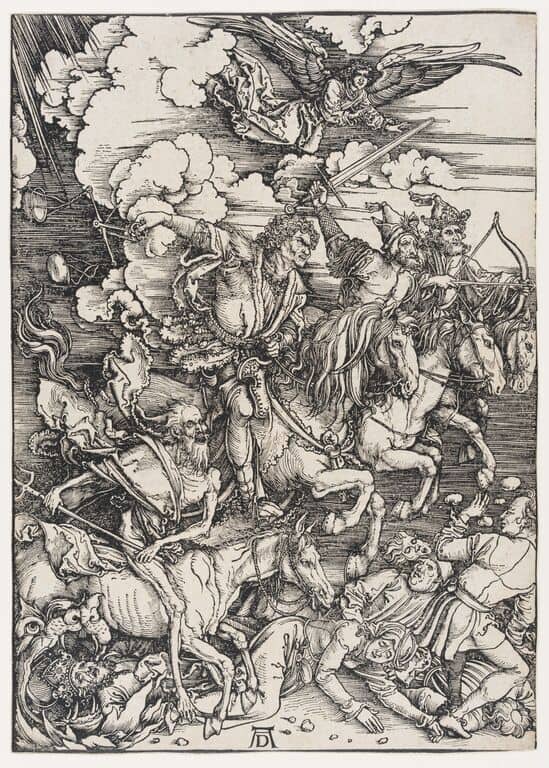
‘The Four Horsemen of the Apocalypse’ or ‘Opening of the Four Seals’, by Albrecht Durer (1471-1528). Illustration to the 1498 edition of the Apocalypse of Saint John, Nuremberg. Woodcut on paper. Image supplied of V&A Museum no E.716-1940, Bequeathed by Miss Alice G.E. Carthew, © Victoria and Albert Museum, London
Charles Robinson’s watercolour called The Song, made between 1930-7 was, amazingly, painted from memory during an evening at a drawing club. It shows a girl watching a bird singing. The almost abstract quality of the paintwork make it appear dreamlike. I came across this artwork by chance and was amazed that he could produce something like this from his imagination, especially the figure of the girl.
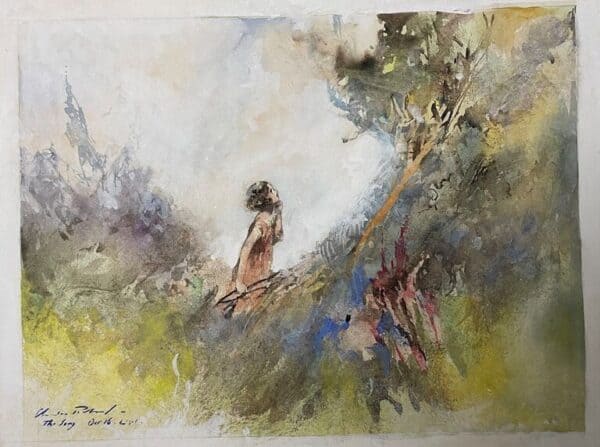
‘The Song’, by Charles Robinson. (1870-1937) Watercolour and gouache on paper, ca 1930-7, Great Britain. Image supplied of V&A Museum no. P.34-1982, Bequeathed by Edith Mary Robinson, © Victoria and Albert Museum, London
Most productive part of your day:
I’m a middle of the day person. I take a while to settle into work and start to flag late afternoon.
Essential skills or training for your role:
Being organised, able to distil and arrange information and stories about objects into broader narratives, and being able to write for different audiences. You also need to be inspired by the objects themselves and driven to undertake research, which tends to be self-initiated. There is no specific qualification needed, but most people tend to be post-graduates in a relevant subject area. Much of the practical training and experience comes through being involved in project work, though.
How do you decompress once you finish work:
On the commute home I do a cryptic crossword or listen to music, usually both. I only truly relax when I get home and have a hot bath. The bath is also where I tend to have ideas.
Looking back, what remains your most rewarding professional experience:
The most challenging, because of the wealth of information needing to be distilled – and the most satisfying, because the peer review feedback was just a one-word ‘excellent’, which is so rare I wish I had kept the note as a memento – was writing some of the gallery text on Rembrandt for our Europe 1600-1800 galleries.
The most interesting show I worked on was a ‘Mapping the Imagination’ display, featuring maps or artworks inspired by maps. As a junior member of the team I helped select some of the material and write gallery texts. We featured many varied works, from historic celestial atlases to contemporary art, which made it a fascinating project to work on.
‘Winnie-the-Pooh: Exploring a Classic’ was my first major exhibition, co-curated with a colleague. I enjoyed working closely with someone else to iron out a narrative. As this was a playful subject we also had fun planning family interpretation with other colleagues and the externally commissioned designers, who were a partnership of architect and theatre designer. This was an unusual level of close collaboration and very rewarding.
If you could take any piece of artwork home with you for a weekend, what would it be:
One of Leonardo da Vinci’s notebooks, but I think I would need it for longer than just a weekend!
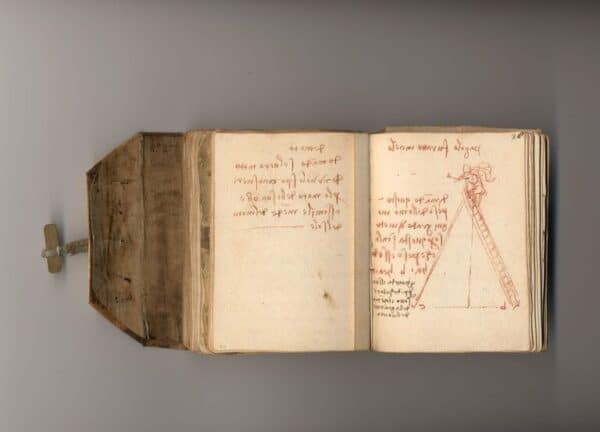
Pages in a notebook (ff. 45 verso-46 recto, shown upside down) of Leonardo da Vinci, known as Codex Forster II. Ink on paper, bound in parchment, ca. 1495 (this opening), ca 1495-7 (volume) Italy. Image supplied of V&A Museum no Forster MS.141, © Victoria and Albert Museum, London. Leonardo da Vinci’s notebooks · V&A
********************
To explore some of the highlights from exhibitions that Annemarie has worked on in recent years, you are welcome to follow the links below:
Beatrix Potter: Drawn to Nature (2022)
Alice: Curiouser and Curiouser (2020)
Making an Impression: the art of relief printmaking (2019)
Winnie-the-Pooh: Exploring a Classic (2017)
The V&A Illustration Awards – a free, biennial competition celebrating excellence in illustration and contemporary practice, and judged by a panel of prominent illustrators and industry experts. First established in 1972, the V&A’s competition is defined by a focus on the British illustration industry, celebrating artwork made for the UK market by artists from across the globe as well as artwork made by illustrators living the UK.