The Varying Roles of Fruit Throughout Art History
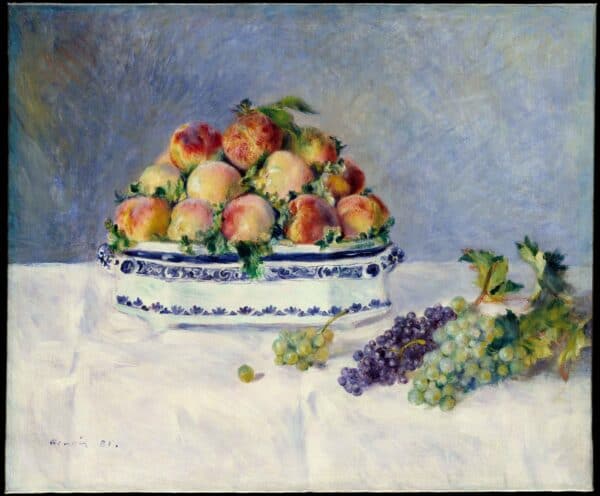
Augustus Renoir, Still Life with Peaches and Grapes, 1881, Oil on Canvas
Typically, when we think of fruit in artwork, we think of scenes of still life. We picture a basket of nature’s freshest and finest delights, perhaps in an ornamental bowl or arranged aesthetically on a table. However, whilst there are many paintings that match this description, aesthetics alone are by no means the only role fruit plays in art.
Throughout art history, fruit has been much more than food to be consumed. It has been used by artists to depict a plethora of religious and mythical meanings, an indicator of wealth, iconography of erotica and a representation of societal advancement. It can be a showcase of an artist’s skills and even a reminder of human mortality.
But fruit can also be as simple as something sweet and delicious to gaze upon. So in today’s journal, in the midst of these summer days, we thought we would celebrate what the sun grows and look at a handful of paintings which demonstrate the varying roles fruit has played. As well as how our selection of artist’s have used the colour blue to inform their fruitful works.
Fruit in Christian Artwork
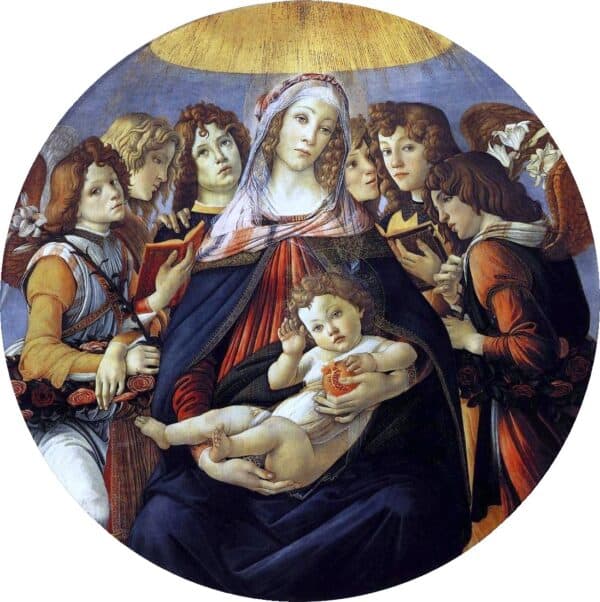
Sandro Botticelli, Virgin and Child with Angels (Madonna of the Pomegranate), c.1487, Tempera on Wood
In the 15th century, out of the hierarchy of genres, still life was considered the least important artistic subject matter. History painting (which includes religion and mythology) were the most important, but this does not mean that fruit was excluded from art. Far from it.
In fact, fruit can be seen in artwork since antiquity, where it was used symbolically in the depiction of Gods and Goddesses. Featuring heavily in both classical and religious literature, such imagery has subsequently been utilised by artists since the Ancient Greeks and Romans.
Come the 1400s and the Renaissance, works such as altar pieces and depictions of the Madonna and child epitomise the inclusion of fruit as theological symbolism. Sandro Botticelli’s tondo (circular) work Madonna of the Pomegranate is a perfect example of this.
In this stunning piece, Botticelli presents the Virgin Mary centrally, under a luminous golden halo, surrounded by angels on both sides. In her arms she holds the child Christ who, gazing directly at the viewer, goes to take the pomegranate that is also being held by his mother. With its flesh exposed, the pomegranate holds a variation of meanings in different contexts (often associated with the Goddess Prosperpine’s binding to the underworld).
However, in this piece, the pomegranate’s rich red colour is symbolically implicative of the blood shed by Christ in the name of human salvation. Botticelli combines this motif with others within the composition. For example the lilies and roses held by the angels that connote the Madonna’s virginity, whilst her traditional, lapis lazuli blue mantle signifies her purity, piety and divinity.
The richness of the blues used by Botticelli are not only unmistakable in their meaning but also integral in the balance and structure of the iconic masterpiece.
17th Century Symbolism
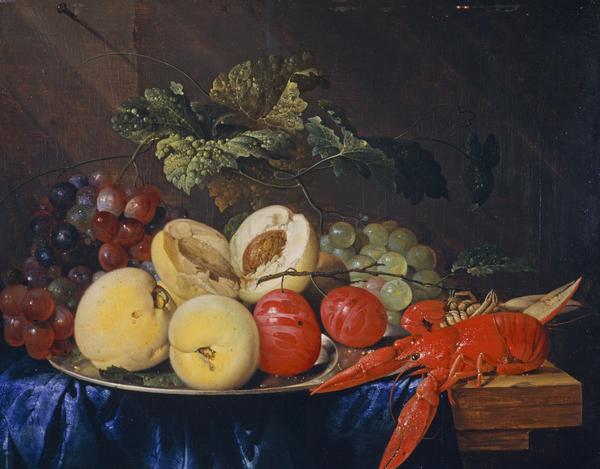
Jan Davidsz. de Heem, A Still Life with Fruit and Lobster, 1650, Oil on Panel
Fruit as a subject matter gradually elevated throughout the Renaissance and into the Baroque movement in Italy. This meant that the 16th century Dutch Golden age of art saw still life paintings of food, and other tabletop items, become both popular and valuable. Yet again, this fixation on depicting fruits was not just about consumption. Instead it was the intent to skilfully present both the current abundance of the nation but also raise questions of morality and mortality
In Jan Davidsz. de Heem’s A Still-life with Fruit and Lobster, the viewer is presented with a myriad of exotic fruits and a cooked red lobster on a silver platter. The imported fruits from the Mediterranean indicate the economic strength of the Netherlands at the time, and the incredible detail in the painting is an exhibition of de Heem’s artistic talent.
However, whilst this collection is pleasing to the eye in its lavishness, it also falls under the theme of vanitas. A trope used in Dutch still life to remind the viewer that grandeur can be fleeting if mistreated. Fruit can rot and wealth can be lost, so don’t indulge in excess.
That being said, De Heem does persist in reminding the audience of said wealth and luxury, by placing the ensemble atop a rich blue fabric. His use of the colour blue contrasts the vivid reds and yellows to create a striking composition, whilst simultaneously emphasising the difference in tone to the blue of the grapes; a sumptuous yet far more natural hue.
19th Century Still Life
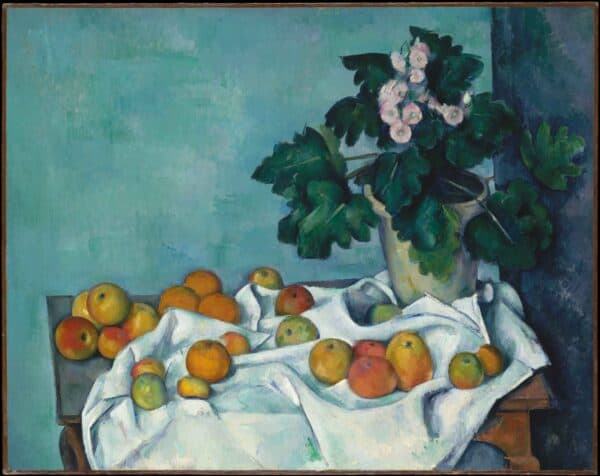
Paul Cezanne, Still Life with Apples and a Pot of Primroses, 1890, Oil on Canvas
As time went on and style evolved, Western art headed towards the bright, shiny lights of Modernism. In this time, our beloved Impressionists and Post Impressionists returned to the subject of fruit as still life.
Whilst there certainly was inspiration taken from the 17th century Dutch painters, unlike in the Netherlands, the avant garde artists were focusing on a less complicated celebration of nature. Focus on symbolism decreased and a desire to create art based around form, colour and style grew. Prime examples of this can be found in the oeuvre of Paul Cezanne.
Cezanne once declared that ‘with an apple I want to astonish Paris’ and astonish he did. Apples became one of the most commonly recurring subjects in his still life pieces, where he repeatedly captured the well-loved fruit from many angles and perspectives – allowing colour and lighting to come into their own.
In Still Life with Apples and Pot of Primroses, Cezanne demonstrates a fantastic command of the colour wheel as a beautiful range of blue tones dominate the background of the painting, as well as the primroses and even the folds of the white table cloth. This allows for the yellow, red, green and orange hues of his apples to pop and project. A wonderful depiction of something so simple yet mesmerising to look at.
Fruit in British Painting
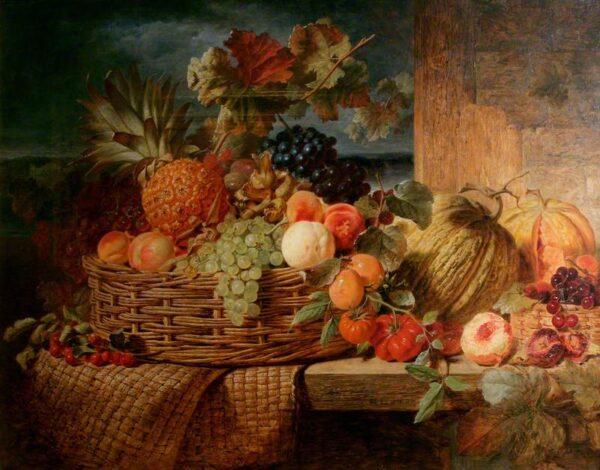
George Lance, Fruit, 1848-1849, Oil on Canvas
Finally, in Britain, fruit was playing another role in the artwork of George Lance. An admirer of the vanitas theme and the Dutch Baroque, Lance produced many works in a similar form and composition to the 17th century masters. However, not only does Lance’s work echo the earlier Dutch style, it also gives us a fascinating insight into the fruits that had become available in England over the last few hundred years.
Lance’s depiction of fruit demonstrated England’s Imperial reach at the time, and the population’s fascination with the foreign. Due to the great costs of import, exotic fruits still weren’t readily available to the public in the 1900s, but their presence had steadily increased in correlation with the industrialisation of the country and advancement in technology.
Interestingly, whilst he was painting at the same time as Cezanne and the Post-Impressionists, Lance’s approach was far more academic. He aimed for naturalism and accuracy in details, which is evident in his colour palette.
In his work Fruit, we witness a brilliant array of produce, from crisp, green grapes to rich, red cherries. The bright light from the left of the painting illuminating each piece of sweet, exotic treasure. The round, golden pineapple being a perfect example of rarity and luxury. Lance achieves the vivid display by employing a reliable deep blue sky in his background.
The fruit sits in wonderful contrast to the moody landscape behind it, made up of deep blue and grey clouds. Allowing the viewer to contemplate each aspect of the work.
A Fruitful History
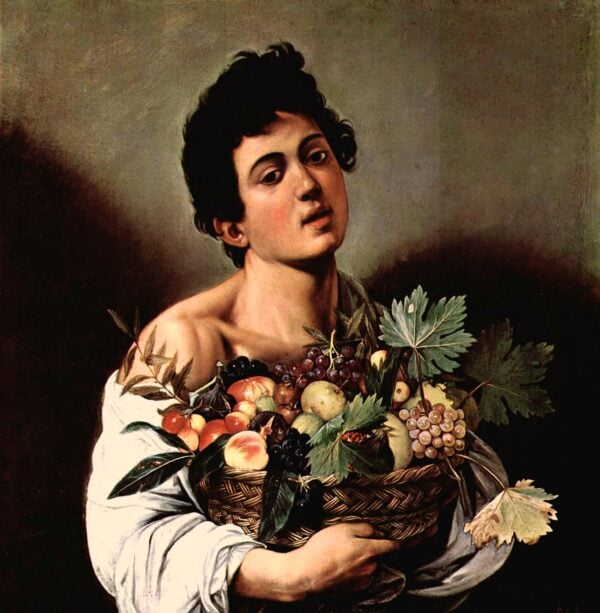
Caravaggio, Boy with a Basket of Fruit, 1593, Oil on Canvas
It would be a near impossible task to touch on every movement, style and artist in which fruit has played an influential and important role. From its origins in ancient Greek and Roman art to the decorative designs of William Morris, fruit is as close to omnipresent as a symbolic image can be in art history.
For all of its symbolism, however, fruits today are often celebrated purely for their temptingly luscious and strikingly decorative qualities. As we head towards the final weeks of summer, and the flush of hedgerow berries, we can all simply relish these seasonal pleasures and the bounty they provide.
“With an apple I want to astonish Paris”
Paul Cezanne