The Busy and the Blissful Blues of British Canals
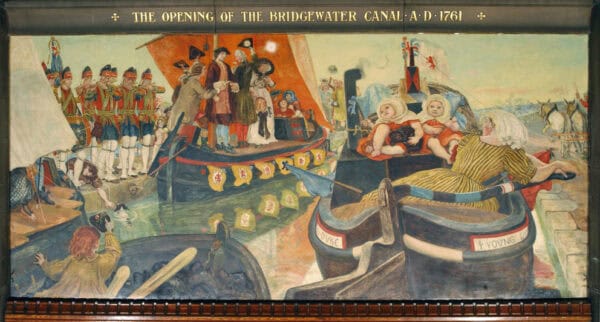
Ford Madox Brown, The Opening of the Bridgewater Canal, AD 1761, 1892, Oil on Canvas
Earlier this month, on 21st of May 1894, Queen Victoria officially opened the Manchester Ship Canal. By this point, Manchester had become recognised as the greatest industrial city in the world and the monumental ship canal led to the Port of Manchester quickly becoming the third busiest port in Britain.
Throughout art history, these incredible feats of engineering and human labour have caught the attention of many great painters. So in honour of the Manchester Ship Canal, and the canals of Britain, we thought we would take a look at a few of the artists that offer us wonderful, and contrasting, insights into the significance of canals; as well as, (naturally!) the way in which the colours blue and white have informed their work.
A Brief History of British Canals
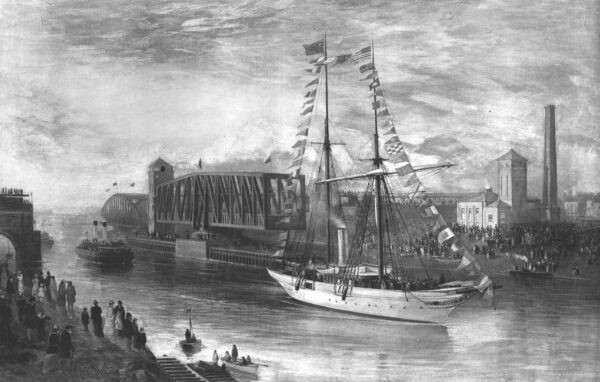
James Mudd, The Opening of Manchester Ship Canal
A canal is an artificial waterway, built to connect two bodies of water and allow for ships and boats to pass from one to the other. They were made largely to enable the more direct transportation of heavy goods and supplies and have played a great role in the progression of many human societies throughout history.
Despite being a man-made piece of infrastructure, many of the canals in Britain, and across the world, have been in place for an extraordinary length of time. The Chinese are generally given the title of pioneering canal engineers, having built the Grand Canal of China in the 10th century.
In Britain, natural waterways became constructed into canals from the mid 16th century, such as the Exeter Canal in 1566. However, it was in the mid 1700s, as the Industrial Revolution kicked off, that the age of canal building came to the fore. The key catalyst of which is attributed to the construction of the Bridgewater Canal.
Completed in 1776, the Bridgewater canal was commissioned by the third Duke of Bridgewater, Francis Eggerton. Inspired by the French Canal du Midi, Eggerton decided to connect his coal mines at Worsely to the industrial hub of Manchester. A move so successful it halved the price of coal in Manchester almost overnight and brought to attention the incredible usefulness of canals that Britain could utilise.
As progression generally dictates, however, something that once was a crucial cog in the machine of industrial Britain is now rarely used for its original purpose. A combined effect of the rise of the railways, as well as the first and second World Wars, nowadays the navigable engineered waterways of the UK are used predominantly for leisure.
The Bustling Banks of City Canals
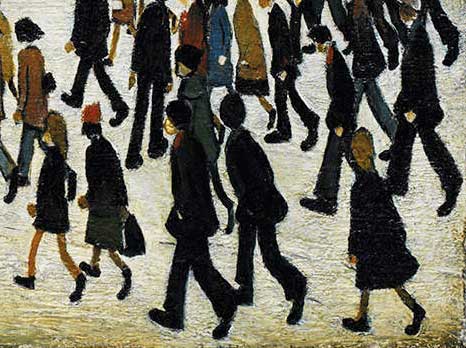
Detail of 1943 painting by L. S. Lowry, Going to Work, Oil on Canvas
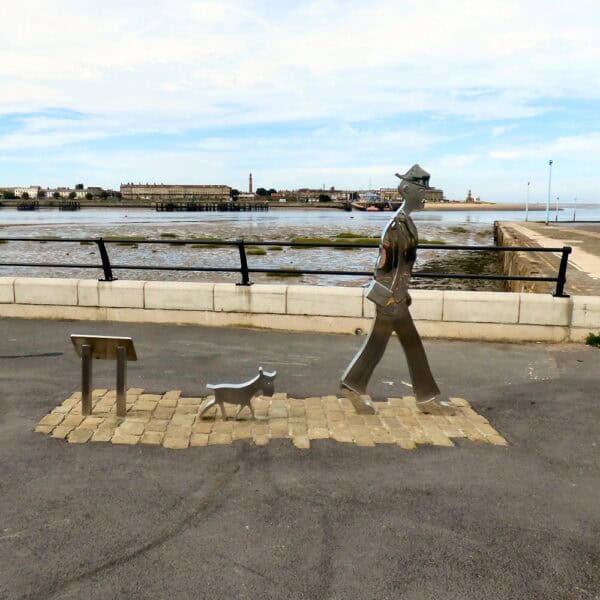
(Attribution:) Matchstick man and his dog – LS Lowry (1887 – 1976) by Gerald England
The associations made with canals in Britain can be somewhat of a dichotomy. On the one hand, canals have become a well-loved part of our natural landscape whilst, on the other, we still feel a strong connection between the canal and the city.
An artist whose work epitomises the latter, is 20th century British artist Laurence Stephen Lowry. Having grown up and always lived in and around Manchester, Lowry learnt to paint as an adult and dedicated most of his talent to depicting the busyness of working life and the industry that surrounded him. Naturally, this included the portrayal of canals.
A perfect example of Lowry’s iconic style is his 1955 painting Canal and Factories. In this oil on canvas work we see a bustling cityscape, with tall factory chimneys, houses, churches and a central canal upon which a selection of ships sail, carrying goods and cargo. The scene is populated by Lowry’s frenetic matchstick people, mostly in the foreground, as the entirety of their everyday life is displayed in the composition behind them.
Lowry’s colour palette is mostly muted in tone. Blue is used to add depth and a layer of grime onto the roof tops and walls of the industrial buildings. Blue grey smoke blows out of the tall chimneys and Lowry tinges the edges of his canal minimally. Only allowing so much colour that the water remains as cold as the busy banks beside it.
Instead of a bright blue sky, Lowry chooses to capture the ‘bleak’ associations made with North country industry by allowing his cityscape to fade to a smoggy off-white. Not only does he achieve a sense of a stark, overcast city, he also creates a clean backdrop for his buildings, canal and matchstick people to stand out against.
Canal Side Calm
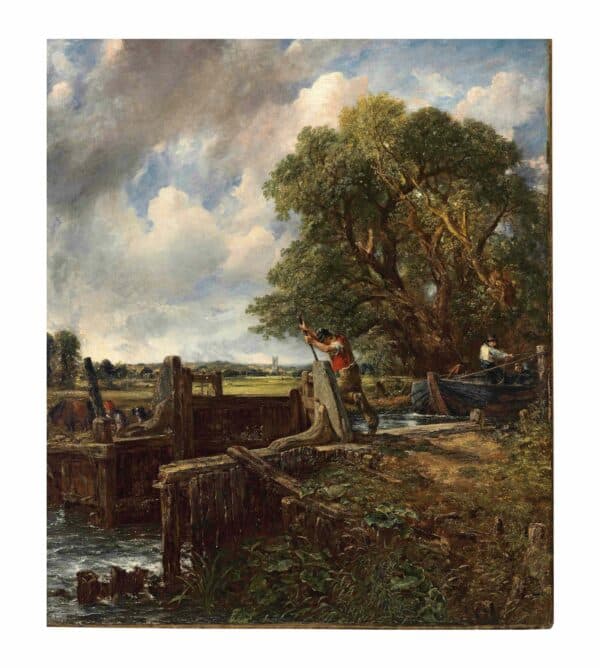
John Constable, The Lock, 1824, Oil on Canvas
In contrast to the intensity of L.S Lowry’s industrial scenes and the hustle and bustle associated with the commercial canal, there are also artists who have captured a very different side to the waterways. They present a much calmer atmosphere, where canals are understood to be ingrained in the British landscape. This can be seen in the works of artists such as Algernon Newton and John Constable.
Algernon Newton was the great grandson of one of the founders of Windsor and Newton, an art material supplier that is much loved to this day. Interestingly, he lived and worked at a time which very much overlapped with Lowry. However, that’s pretty much where their similarities end.
Given his epithet as the ‘Canaletto of canals’, it is unsurprising that Newton’s favoured subject matter were canal side scenes. Unlike Lowry, however, Newton captured a serenity and stillness in his works which brought out the romantic side to the canal.
Newton’s work The Surrey Canal, Camberwell shows a scene set at dusk, as an unpopulated stretch of the Surrey canal quietly ripples in front of Victorian terraced houses. Newton is known to enjoy finding the beauty in the desolate and the forlorn and, in this quiet, somewhat simple composition, he delightfully romanticises the canals of the back streets of London.
In the same way that Newton’s painting is the opposite to Lowry’s in its atmosphere, Newton’s use of the colour blue is also a complete contrast. Whilst Lowry uses the cool toned blues to enhance the bleakness of his scenes, Newton captures the magical feeling that dusk brings through his use of a soft twilight sky. The darker blue of the water is lit up by a warm glow of a lamppost, enhancing the tranquility and depth of the piece.
Canals in the Countryside
Not only can we find a more peaceful portrayal of the canal in Newton’s oeuvre, but in John Constable’s painting The Lock. Here the viewer gets to witness a scene that still brings joy to watch in real life today. Reaffirming also the canal’s rightful association with nature and the countryside.
One of the most impressive pieces of engineering, when it comes to canals, is arguably the lock system. In this work Constable presents a lock keeper carrying out his job in order for the boat waiting patiently to continue onwards. The large and impressive tree behind the lock parallels the strength used in the laborious process, whilst the dynamism of the river highlights nature and man working together.
Constable uses brushstrokes of blue and white to make the flowing water twinkle. The colour takes away our ideas of dirty canal water and replaces them with presentations of the pastoral, whilst the lush greenery is set off against the vast blue skies – typical of the romantic style.
A Continued Love of Canals in Modern Art
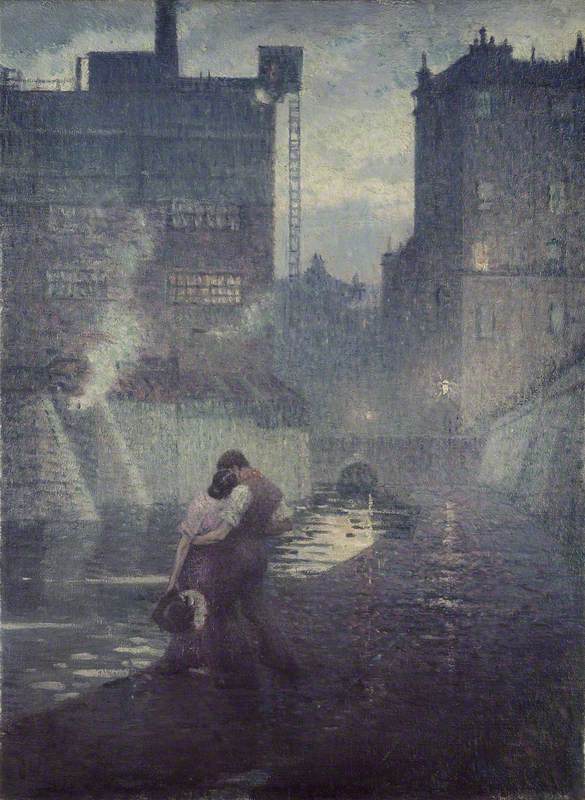
Christopher Richard Wayne Nevinson, The Towpath, 1912, Oil on Canvas
As we can tell from the selection of paintings we have looked at today, the canal is a celebrated part of Britain’s landscape and its history. Through the eyes of different artists we can see the different atmospheres that are to be found on the banks of a canal. And it is a subject matter that still captures many today, such as in the works of Surrey artist Liz Seward.
“The canals, once the highways of commerce, are now the quiet backwaters of the countryside, full of nostalgia and beauty.”
— John Betjeman, Metroland (BBC, 1973)
Poet Laureate from 1972 – 1984