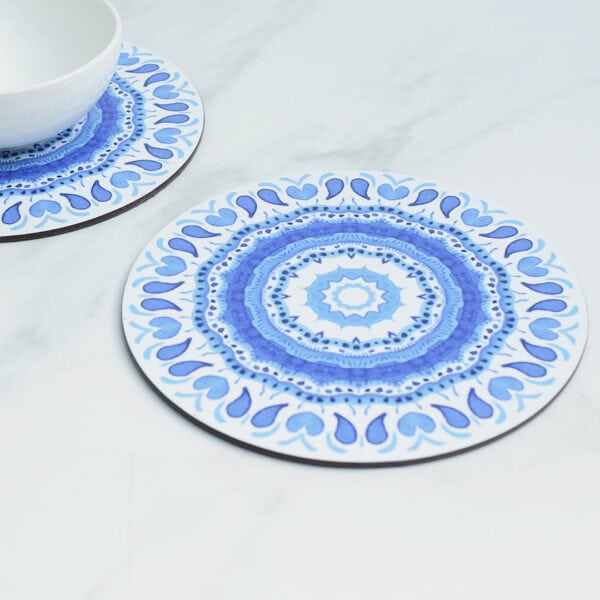
The Significance of Circles in Art
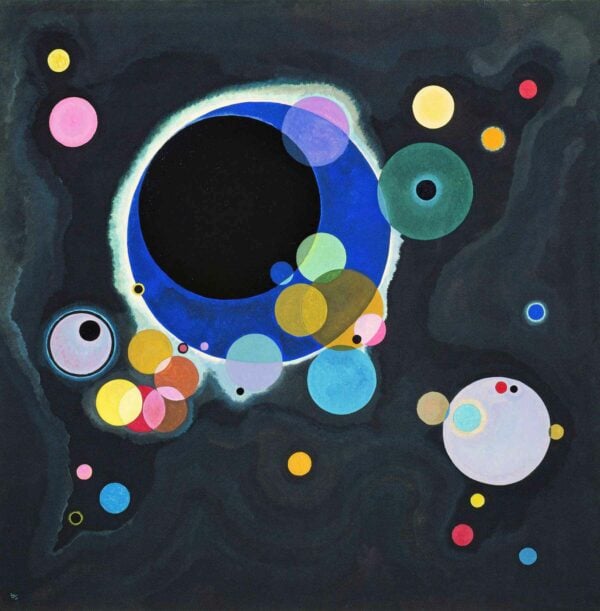
Wassily Kandinsky, Several Circles, 1926, Oil on Canvas
Something so simple yet so intrinsically recurrent, the circle is a symbol that is so much more than a geometric shape. From ancient civilisations to modern art movements, we see circles form patterns, signify meaning and act as autonomous and focal forms in art.
Without beginning or end, a circle can symbolise unity, infinity and divinity (as well as embracing many other theories) and so in this journal we thought we’d have a look at the significance of circles in a variety of contexts and artworks.
The Symbolism of the Circle
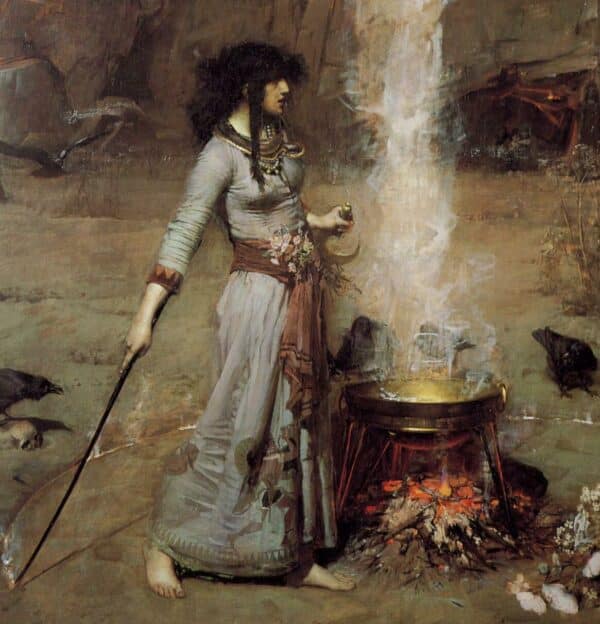
John William Waterhouse, Magic Circle, 1886, Oil on Canvas
The circle is a form that appeals to human nature through its profound simplicity. It is a shape that is found in abundance in nature; the iris of an eye, ripples on water, rings in a tree trunk, the pattern on a butterfly’s wing. As well in celestial bodies such as the sun and the moon. They are familiar, almost omni-present. If you were to look around the space you’re in right now, you’d probably find a circle pretty quickly.
Perhaps this is why they have entered human art so prevalently. Maybe it’s why the symbolism we attach to them is so natural. The symbolism we are referring to being a variety of different interlinked concepts and ideas.
In many cultures and religions circles represent eternity, divinity, unity and wholeness. This can be seen in both figurative representations, such as the circular glow of a halo in Western art, or in the decorative design of non-secular architecture (which we will come to later). Found in mandalas in Hinduism and Buddhism, concentric circles represent cosmic balance, whilst in Paganism circles imply magic and mysticism, you are welcome to explore our earlier Journal entry The Calming Map of a Mandala to read more on this theme.
As the circle and religion walks hand in hand, they are also found in secular art. Their symbolism being so malleable and non-binary that they appeal to artists of abstract matter and ideas. The circle is so fundamental that Psychologist Carl Jung even identified it as an archetype of the ‘self’, representing the totality of the psyche. Examples of all of which we shall now explore.
Rembrandt’s Enigmatic Portrait with Two Circles
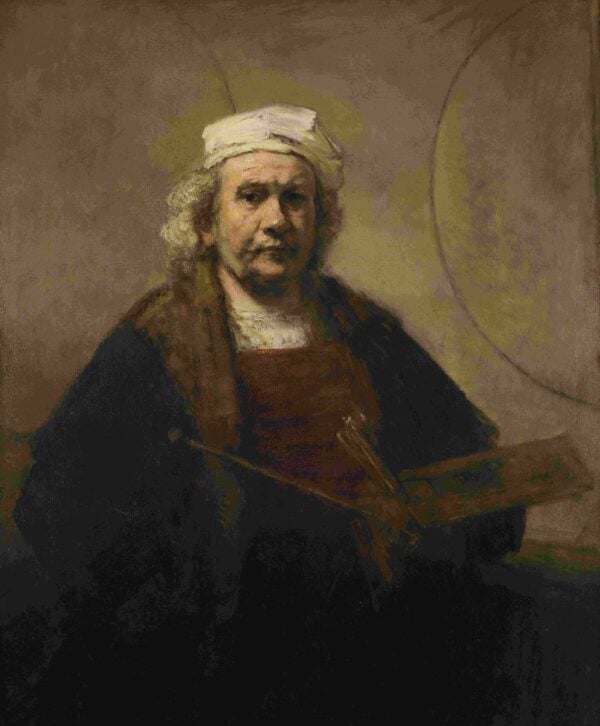
Rembrandt van Rijn, Portrait with Two Circles, c. 1665, Oil on Canvas
Firstly, whilst in the modern era and religious contexts, artists can frequently be seen using circles as abstract elements or in patterns, earlier Masters occassionally embedded them more subtly in their art. One of the most intriguing examples of this is Rembrandt van Rijn’s Self Portrait with Two Circles.
Known for his dedication to capturing human emotion through the method of self-portraiture, this particular painting is considered to be one of Rembrandt’s masterpieces. However, the inclusion of the two circles has been greatly debated. In the piece, Rembrandt presents himself as an aging artist, perhaps more confident now in his ability and his career. He holds his palette and brushes as he gazes directly at the viewer.
In the background we see a plain wall on which two large, faint circles are inscribed. Some scholars believe the inclusion of these forms reference Giotto, who proved his artistic genius by being able to free handedly draw a perfect circle. Rembrandt’s depiction of himself as an accomplished and wisened painter may be paralleled in this metaphor. Another theory suggests he is alluding to the perfection of God.
Whatever the true meaning behind the circles in Rembrandt’s work, they undeniably add a layer of depth and mystery that makes the viewer question what they are observing. Perhaps that is the entire point, which would make Rembrandt more than a craftsman but a philosopher of his art.
Delaunay and Kandinsky: The Abstract Power of Circles
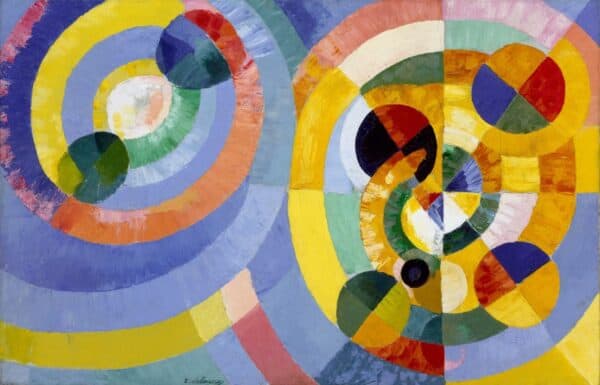
Robert Delaunay, Circular Forms, 1930, Oil. on Canvas
In the advent of abstract modern art however, the circle took on a new significance. The 20th century saw artists such as Wassily Kandinsky and Robert Delaunay use the shape not only as a symbol but as a compositional tool, capable of evoking movement and emotion.
Through the use of shape and colour, Robert and Sonia Delaunay developed the movement known as Orphism. Fascinated by colour theory and the rhythms of urban life, Orphism was inspired by Cubism but focused on the idea that art should be like music. Circles played a leading role in Delaunay’s Ophismic work, as he frequently used circular forms to create a visual symphony that evoked a multi sensory experience.
Similarly, later in his career, Wassily Kandinsky went on to explore the spiritual potential of the circle. As Kandinsky looked at representing a higher power in the cosmos, he utilised the circular form in many different and repeating ways. This exploration into the shape culminated in his work Several Circles, in which he presents cosmic vastness via the arrangement of varying-sized circles on a dark, deep background.
Circles in Islamic Art
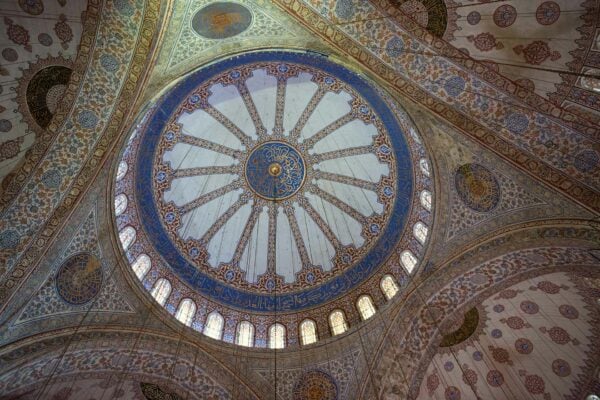
Interior of Blue Mosque, Istanbul, Turkey
Finally, a different form of art in which we are met with the presence of circles is in decor and architecture. Specifically, in the breathtaking designs of Islamic mosques. As we mentioned earlier, circles are often found in many religions and its art. However, as Islam prohibits the depiction of living creatures in its artwork, this particular religion has chosen complex geometric patterns to decorate its sacred spaces.
Circles are often at the core of these intricate designs and they act as a repetitive motif which creates a sense of order and divinity. The domes of mosques themselves echo the shape of perfect hemispheres, representational of the heaven Allah’s devoted subjects aspire to reach. The colour blue is also an important part of these circular designs, often associated with heaven, divinity, contemplation and reflection.
Circles, a Universal Symbol
As we can see from the variety of artwork found within this journal, circles are a universally versatile and persistently used form. From the symbolic representation of eternity in Islamic art to the enigmatic subtleties of Rembrandt’s masterful hand, circles can be found throughout art history. Making us ask questions as well as offering us answers, circles can be pleasing, challenging, beautiful and inspiring; connecting the most unlikely artists and cultures throughout the history of the world. Contemporary yet rooted in history and the universe around us.
As we celebrate the circle and its significance in art history, we have recently released a range of table linen including our Blue Circles napkins and continue to love the circular placemats and coasters within our range as well. We hope you love them too!

“The circle is the most modest form, but asserts itself unconditionally”
Wassily Kandinsky, Point and Line to Plane.
Translated by Howard Dearstyne and Hilla Rebay, Solomon R.
Guggenheim Foundation, 1947